Bollettino SPI Vol. 65 (1)
Published in June 2026
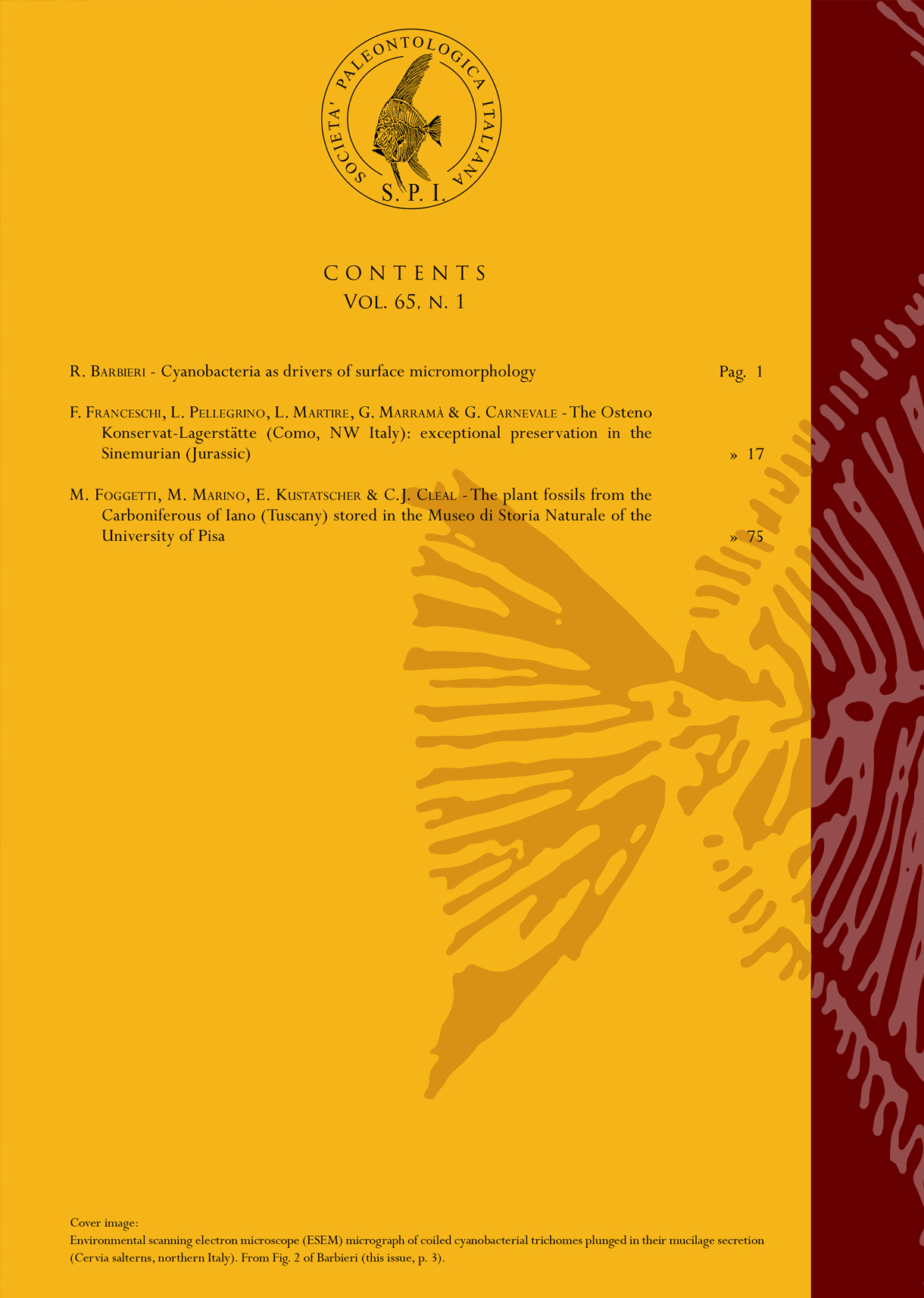


Index
- Barbieri R. (2026) – INVITED PAPER – OPEN ACCESS
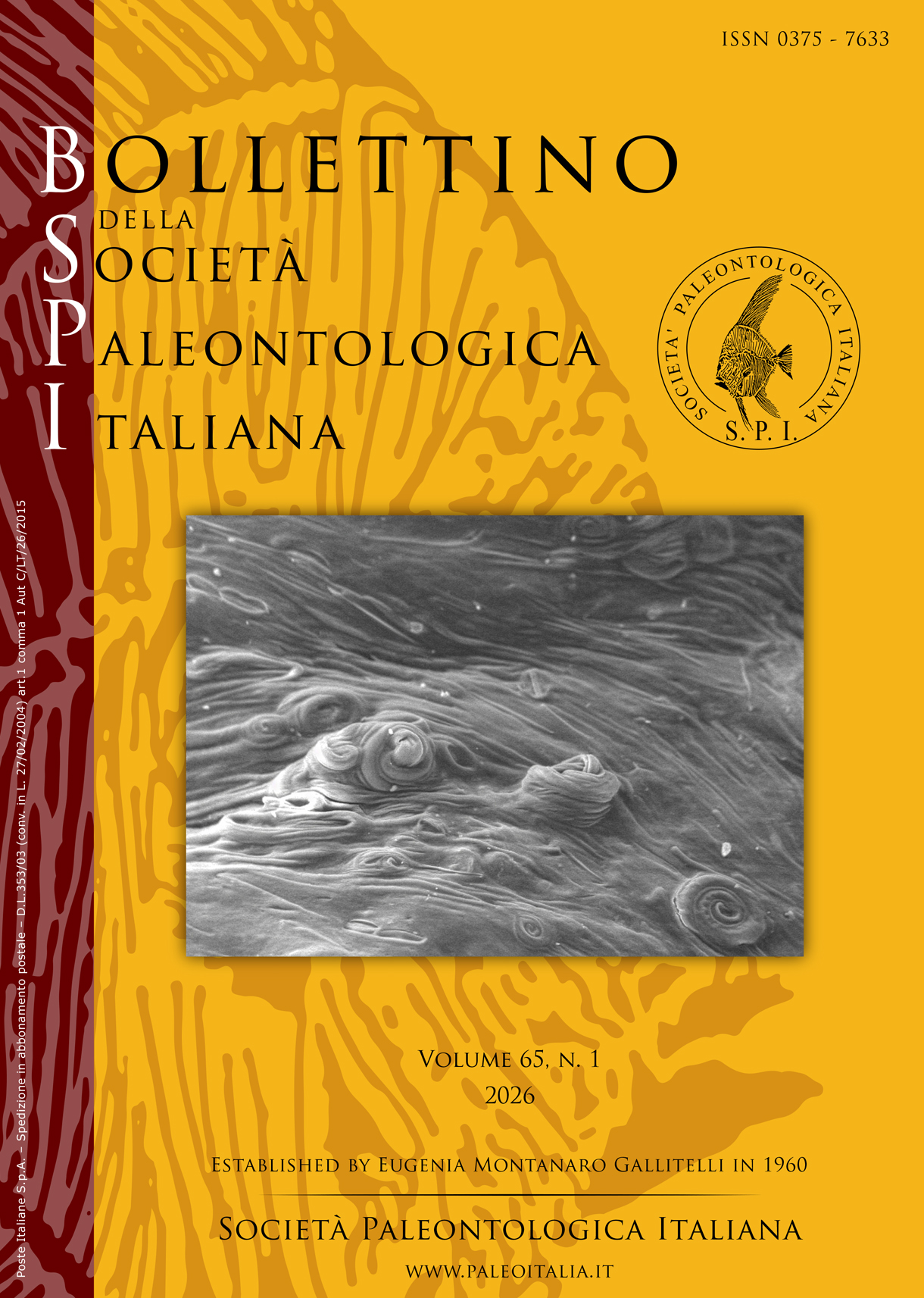
Cyanobacteria as drivers of surface micromorphology
pp. 1-15
doi:10.4435/BSPI.2026.02
Throughout their extensive geological history, cyanobacteria –one of the biosphere’s most successful prokaryotic groups– have been a driving force behind pivotal events shaping the planet’s biological and physical evolution. Cyanobacteria, particularly those possessing filamentous morphology, have interacted so significantly with the formation of sedimentary deposits that they have become key drivers in the micromorphological evolution of the Earth’s surface. Their ability to bind loose sediment has manifested across diverse spatial and temporal scales, establishing biosediment as a critical factor in the formation of surface landforms. In addition to sediment stabilization, cyanobacteria are active agents in rock weathering and soil formation. The impact of cyanobacteria on geobiology and sedimentology is attributed not only to their morphology but also to their bioecology, which involves extracellular polymeric substance (EPS) production for biofilm formation and the capacity to establish symbiotic relationships with other prokaryotic and eukaryotic microorganisms. The most remarkable manifestation of this architectonic capacity is the formation of stromatolites. This paper summarizes how cyanobacteria act as agents that shape surface micromorphologies on Earth.
- Franceschi F., Pellegrino L., Martire L., Marramà G. & Carnevale G. (2026) – OPEN ACCESS
The Osteno Konservat-Lagerstätte (Como, NW Italy): exceptional preservation in the Sinemurian (Jurassic)
pp. 17-73
doi: 10.4435/BSPI.2026.01
This review provides a comprehensive synthesis of the Lower Jurassic Osteno Konservat-Lagerstätte, integrating a systematic revision of the fossil remains with novel sedimentological and geochemical data to interpret the complex depositional history of the site. A pivotal finding is the re-interpretation of the fossiliferous interval as a laminated spiculite, wherein sponge spicules constitute up to 25% of the rock volume, fundamentally shifting previous interpretations of the sedimentary environment. This sedimentological baseline, combined with geochemical proxies indicating anoxic porewaters and an Ichnofabric Index of 0, enables the reconstruction of a precise chain of diagenetic events. In particular, the study identifies a microbially-driven process that facilitated the exceptional phosphatization of soft tissues and the early cementation of the sediment. The fossiliferous deposit originated close to a prolific “sponge ground” situated on the outer ramp (100-200 m depth). This oxygenated habitat acted as the biological source for a parautochthonous assemblage, dominated by decapod crustaceans and thylacocephalans, which was subsequently transported into an adjacent, transiently anoxic depression. This source-to-sink model explains the unique preservation biases, establishing Osteno as a crucial reference for understanding the Sinemurian marine ecosystem diversity.
- Foggetti M., Marino M., Kustatscher E. & Cleal C.J. (2026)
The plant fossils from the Carboniferous of Iano (Tuscany) stored in the Museo di Storia Naturale of the University of Pisa
pp. 75-93
doi:10.4435/BSPI.2026.03
The fossil plant assemblage of the Scisti e Arenarie di Iano Formation, housed in the Museo di Storia Naturale of the University of Pisa (Calci, PI), documents a diverse Late Pennsylvanian wetland flora. It includes representatives of arborescent sphenopsids, marattialean ferns, seed ferns, arborescent lycopsids, and cordaitaleans. Sphenopsids are very abundant in the collection, represented by remains attributed to Calamites, Annularia, Calamostachys, and Sphenophyllum. Marattialean ferns form a diverse component of the assemblage and include fronds referred to as Acitheca, Crenulopteris, Lobatopteris, Diplazites, and Cyathocarpus. Seed ferns are documented by leaf fragments of Callipteridium, Eusphenopteris, and Neuropteris, as well as seeds attributed to Trigonocarpus. Arborescent lycopsids are represented by Sigillaria and Aspidiopsis, while cordaitaleans are documented by rare leaf fragments. The Iano flora belongs to the Variscan paleotropics and likely developed in a coastal, swamp-dominated environment along the southwestern margin of the Paleotethys. The taxonomic composition of the assemblage suggests that the vegetation lived under humid conditions with episodic marine influence, providing new insights into the paleoecology of late Carboniferous wetland forests in southern Europe.