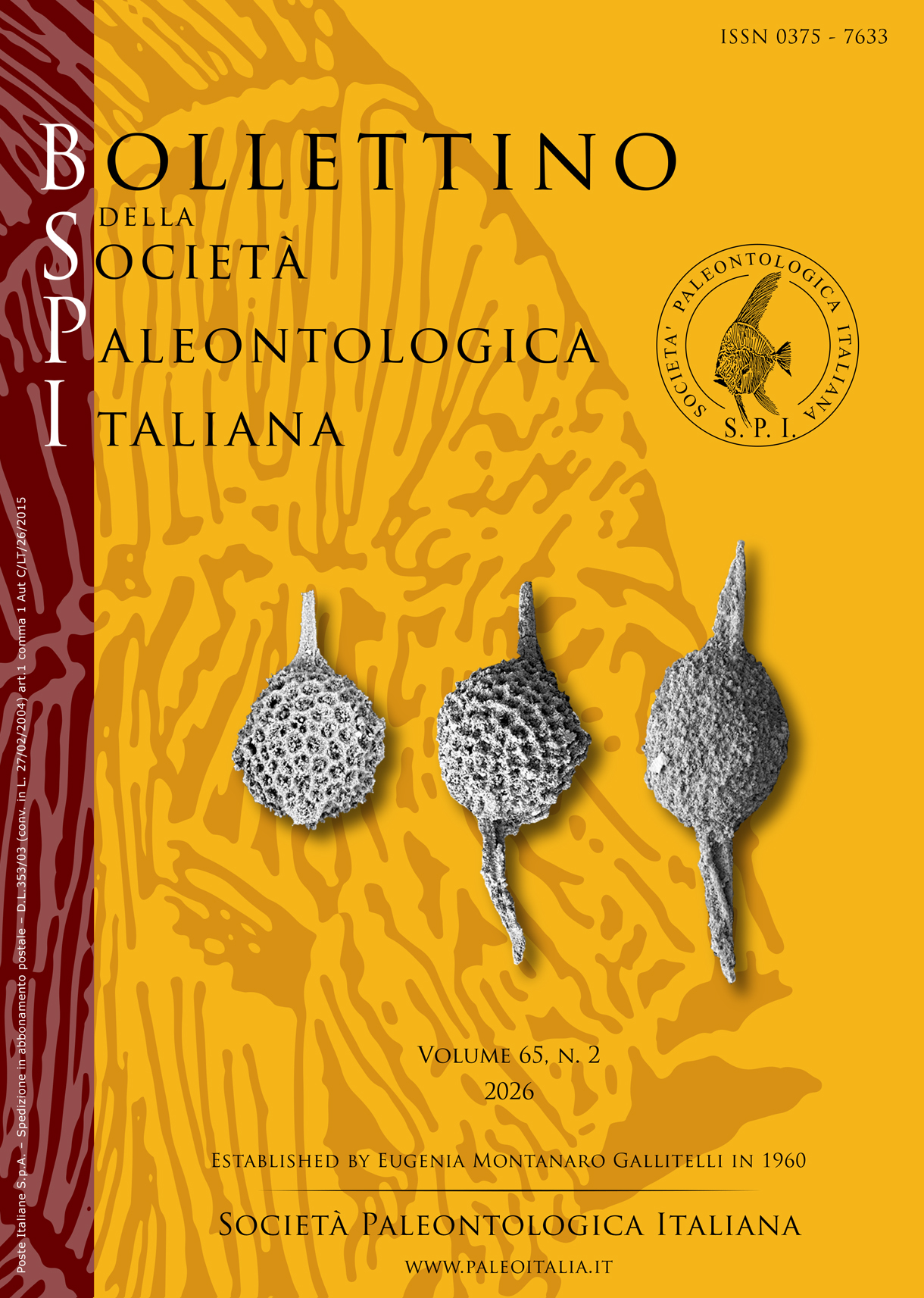
Bollettino SPI Vol. 65 (2)
Published in September 2026


Index
- Bannikov A.F., Zorzin R. & Carnevale G. (2026)
A putative butterflyfish from the Eocene of Monte Postale, northern Italy
pp. 95-100
doi: 10.4435/BSPI.2026.04
A fossil butterflyfish is described based on a single specimen from the Eocene of the Monte Postale site, Bolca Lagerstätten, northern Italy. Despite its poor preservation, the fossil exhibits a set of features that justify its attribution to the family Chaetodontidae, especially the sequential articulation between first dorsal-fin pterygiophore, supraneurals, and supraoccipital crest. The incompleteness of the specimen, however, does not allow for a more detailed taxonomic attribution. This fossil represents the earliest documented Chaetodontidae in the fossil record and provides additional evidence about the relevance of the Bolca Lagerstätten in the interpretation of origin and evolution of the modern reef communities.
- Pagliuzzi E., Marramà G., Delfino M., Medin T. & Carnevale G. (2026)
Pleistocene fish remains from the Aalat Formation, Dandiero Basin, Eritrean Danakil Depression
pp. 101-111
doi: 10.4435/BSPI.2026.05
The Pleistocene continental deposits of the Dandiero Basin (Northern Danakil Depression, Eritrea) are well known for the 1 Ma in age well-preserved erectus-like human remains. In addition, the productive sites of this rift basin have yielded numerous fossils documenting a rich Early to Middle Pleistocene vertebrate fauna of fishes, reptiles, birds and mammals. In this paper, we describe the bony fish remains collected from the Aalat Formation exposed in three different sites of the Dandiero Basin, including the Buia Homo site, Mulhuli-Amo and Dioli. Fish remains from these localities comprise a relatively well-preserved articulated head skeleton plus several isolated cranial and postcranial bones pertaining to the catfish genus Clarias, a pharyngeal tooth tentatively referred to the cyprinid genus Labeobarbus, and isolated vertebrae and a median-fin spine assigned to the family Cichlidae. The fish assemblage is indicative of the presence of heterogeneous fluvio-lacustrine habitats during the late Early Pleistocene of the Dandiero Basin.
- Martin J.E., Albayrak E., Saraç G., Karadenizli L., Antoine P.-O., Métais G., Peigné S., Aslan F., Şimşek E., Göçer D. & Sen S. (2026)
The first occurrence of the eusuchian Diplocynodon from the Oligocene of Anatolia
pp. 113-123
doi: 10.4435/BSPI.2026.06
The small to medium-sized eusuchian Diplocynodon was a common component of fluviolacustrine habitats during the Paleogene and Neogene of Europe. Given its abundance in Western and Central European localities, it is currently considered a European endemic taxon. Although sparse, a fossil record exists however on the easternmost outreaches of the subcontinent. As no continuous physical barrier with Asia was identified during the Paleogene, the former distribution of Diplocynodon and its absence in Cenozoic deposits of Asia are questionable. Herein, we describe a partial skeleton attributable to Diplocynodon sp. from the Oligocene of Central Türkiye. The new material resembles other Oligocene species of Diplocynodon, notably that from the Rupelian of Monteviale, Italy. The rather vague taxonomy surrounding the Oligocene representatives of Diplocynodon prevents a species assignment for the new Turkish specimen. Together with previous reports from Ukraine, the Turkish discovery represents the easternmost record of the genus and questions the biogeographic boundary with contemporaneous eusuchians from Asia. Diplocynodon had a wide distribution during Oligocene times, encompassing, from West to East, Spain, France, Italy, Bulgaria and Türkiye.
- Ozsvárt P., Bahramnejad E., Zajzon N., Damani Gol S. & Baghieri S. (2026)
Late Cretaceous (Santonian) radiolarians from the Fannuj-Maskutan ophiolites, Makran Zone, SE Iran
pp. 125-141
doi:10.4435/BSPI.2026.07
The Fannuj-Maskutan ophiolite (FMO) is exposed in the central sector of the Makran Accretionary Prism in southeastern Iran and represents one of the largest ophiolitic complexes in the region. The ophiolite comprises a well-developed lithostratigraphic succession including mantle peridotites, plutonic complexes, volcanic rocks, and associated pelagic sedimentary units such as radiolarites and radiolarian shales. A moderately to poorly preserved, yet relatively diverse radiolarian assemblage was obtained from a radiolarite sample collected within the ophiolitic sequence. In total, 51 taxa belonging to 25 genera were identified, including 22 species and 29 taxa in open nomenclature. The assemblage is dominated by nassellarian radiolarians, particularly representatives of Stichomitra and Dictyomitra spp. Biostratigraphically significant taxa include Dictyomitra koslovae Foreman, 1975, Stylosphaera hastata (Campbell & Clark, 1944), Pseudotheocampe urna (Foreman, 1971), and Archaeospongoprunum salumi Pessagno, 1973. The stratigraphic ranges of these species indicate a probable Coniacian-early Campanian age, most likely Santonian. These results provide new biostratigraphic constraints on the sedimentary cover of the Fannuj-Maskutan ophiolite. The available data suggest that Neotethyan ophiolites within the Makran Accretionary Prism formed during a time interval spanning from the Aptian-Albian to the Campanian, with the youngest biostratigraphically constrained pelagic sequences so far documented in the Fannuj-Maskutan ophiolite.
- Ferretti A., Rigo M., Lugli F., Świś P.L., Malferrari D., Letulle T. & Medici L. (2026) – OPEN ACCESS
Early biomineralization in conodonts
pp. 143-161
doi:10.4435/BSPI.2026.08
Conodonts represent the earliest vertebrate group to have developed extensively mineralized tissues, providing a unique record of the early evolution of vertebrate biomineralization. Herein, we investigate the crystallographic differences between paraconodonts and euconodonts through an integrated characterization of their bioapatite structure. A broad dataset of conodont elements ranging from the Cambrian to the Triassic was investigated by electron microscopy and X-ray microdiffraction, with particular emphasis on bioapatite unit-cell parameters, Crystallinity Index (CI) and number of coherently diffracting unit-cell repeats. Taken together, the investigated parameters reveal distinct crystallographic distributions for paraconodonts and euconodonts. Paraconodonts occupy a comparatively restricted crystallographic field, characterized by lower a and higher c unit-cell parameters, smaller unit-cell volumes, lower CI values, and smaller crystallite dimensions, whereas euconodonts show generally higher crystallinity and substantially greater crystallographic variability. Although carbonate content was not measured directly, the unit-cell differences are consistent with higher carbonate content in paraconodont bioapatite. Differences in crystallite development along the a and c axes further suggest that the transition to the euconodonts did not involve a simple increase in crystallinity or isotropic crystal growth, but rather a reorganization of apatite at the crystallographic scale. No clear differences were detected between basal and denticle regions in selected euconodonts, and CI showed no clear association with the conodont Color Alteration Index (CAI). The group-level crystal-chemical differences may retain a biological component, although unequal sample sizes, taxonomic composition, and diagenetic variability limit its isolation. Remarkably, the mineralogical differences identified herein between paraconodont and euconodont bioapatite parallel those distinguishing dentine and enamel/enameloid in more advanced vertebrates. More specifically, qualitative comparison with differentiated dental tissues of fossil and extant catsharks reveals partial correspondence between paraconodonts and shark roots and between euconodonts and shark crowns, although these similarities do not imply tissue homology. This correspondence suggests that the transition from paraconodont to euconodont mineralization may have captured an early stage in the differentiation and specialization of vertebrate mineralized tissues, potentially providing insight into the emergence of distinct tissue types during the early evolution of the vertebrate skeleton.
- Bannikov A.F. & Carnevale G. (2026)
Bartonian priacanthid fishes (Teleostei, Eupercaria) from the Kuma Formation, North Caucasus, Russia
pp. 163-181
doi:10.4435/BSPI.2026.09
Priacanthid fishes are primarily nocturnal predatory eupercarian percomorphs that occur circumtropically with a peak of diversity in the Indo-Pacific region. The fossil record of the priacanthids is relatively rich with several Cenozoic taxa described based on articulated skeletal remains and otoliths. Herein, we present a descriptive analysis of the priacanthid fishes from the Bartonian Kuma Formation, Gorny Luch locality, North Caucasus, Russia. Two new taxa have been recognized based on 49 specimens, Parapristigenys marramai n. gen. n. sp. and Priacanthus pellegrinoi n. sp. The fossil record of the Priacanthidae is also discussed.