Bollettino SPI Vol. 65 (3)
Published in December 2026


Index
- Lombardi M., Viaretti M., Reitano A., Henderson C.M., D’Arpa C., Insacco G. & Angiolini L. (2026) – OPEN ACCESS
Systematic study of three brachiopod orders Dictyonellida, Productida,
Orthotetida from the Permian Sosio Limestone, Palazzo Adriano, Sicily
pp. 183-235
doi: 10.4435/BSPI.2026.10
The Sosio Limestone is renowned worldwide as one of the most important units for the study of Permian fossil invertebrates of a fore-reef or upper slope environment. This study focuses on 223 brachiopod specimens selected from the much larger collection housed at Museo Civico di Storia Naturale of Comiso (Ragusa, Sicily) and collected from three of the five megablocks of the Sosio Limestone in the Sosio Valley. The systematic description and classification of the specimens led to the identification of 36 taxa belonging to the orders Dictyonellida, Productida and Orthotetida, highlighting a much higher biodiversity within these groups than previously reported in the literature. The identified brachiopods have rather long stratigraphic ranges; however, the occurrence of Costachonetina sp. and Comuquia modesta Grant, 1976 may constrain the age of the Sosio Limestone to the Roadian-Wordian (Guadalupian), as also supported by the recovered conodont fauna. Functional morphological analysis of three identified morphogroups provided insights into the likely modes of life of the studied brachiopods. Both the concavo-convex/plano-convex morphogroup and the conical non coralliform/subconical/elongated morphogroup are interpreted as having had a semi-infaunal lifestyle. However, their different morphology enabled the latter morphogroup to attain a slightly higher position above the water-sediment interface, allowing more efficient suspension feeding and a larger, even if variable, size. The conical coralliform morphogroup is interpreted as having had an epifaunal lifestyle, attached to hard substrates through cementation by means of a cicatrix of attachment and the spines. This allowed a more efficient suspension feeding, and the attainment of a generally larger size. The occurrence of brachiopods with different lifestyles indicates that a wide variety of substrates was present in the fore-reef or upper slope environment recorded by the Sosio Limestone. The large occurrence of conical coralliform brachiopods, attached to the substrate, suggests the presence of hard substrates. Instead, semi-infaunal brachiopods indicate the occurrence of areas of deposition of fine sediments and muddy bottoms. Such areas could have been variably extended or, if localized, extremely frequent, supporting the high number of semi-infaunal brachiopods.
- Roghi G. & Rigo M. (2026) – OPEN ACCESS
Palynological record across the Norian-Rhaetian boundary at Pignola-Abriola
(Southern Apennines, Italy): implications for marine-continental correlation
pp. 237-250
doi: 10.4435/BSPI.2026.11
The formal definition of the base of the Rhaetian Stage remains unresolved, and correlation of the Norian-Rhaetian boundary (NRB) between marine and continental successions is complicated by the use of different biostratigraphic frameworks and by pronounced floral provincialism. Here we present the first detailed palynological record across the NRB from the Pignola-Abriola section (southern Apennines, Italy), a candidate Global Stratotype Section and Point (GSSP) for the base of the Rhaetian. Of 33 samples investigated, 16 yielded identifiable palynomorphs, allowing recognition of three terrestrial (T1-T3) and three marine (M1-M3) assemblages. Their stratigraphic distributions are calibrated against the established conodont and radiolarian biostratigraphy, δ¹³Corg record and magnetostratigraphy of the section. A key result is the first observed occurrence of Rhaetipollis germanicus within the upper Norian, below the independently constrained NRB, demonstrating that its first occurrence does not coincide with the base of the Rhaetian at Pignola-Abriola. Conversely, Patinasporites densus, Vallasporites ignacii, Enzonalasporites sp. and Duplicisporites granulatus have their last observed occurrences within the Norian part of the succession. Comparison with European palynostratigraphic schemes and the Newark Supergroup reveals substantial regional differences in the observed ranges of several key Late Triassic sporomorph taxa, consistent with strong palaeogeographic and climatic control on floral distributions. Because the Pignola-Abriola magnetostratigraphy is independently correlated with the Newark Astrochronostratigraphic Polarity Time Scale, its palynological record provides a direct link between the marine western Tethyan chronostratigraphic framework and continental North American palynofloras. The integration of terrestrial sporomorphs with independently calibrated marine stratigraphic proxies therefore adds an important correlation tool to Pignola-Abriola as a candidate GSSP and extends the correlation potential of the proposed NRB to continental successions lacking marine biostratigraphic markers.
- Mulé F., Pandolfi L., Casati S., Merella M., Di Cencio A., Pieri A., Bonfigli L., Panetta D., Sorbini C., Bianucci G., Rook L. & Collareta A. (2026) – OPEN ACCESS
Late Pliocene terrestrial mammals from La Serra, a new Early Villafranchian fauna with well-documented stratigraphy near Montopoli (Tuscany, central Italy)
pp. 251-278
doi: 10.4435/BSPI.2026.12
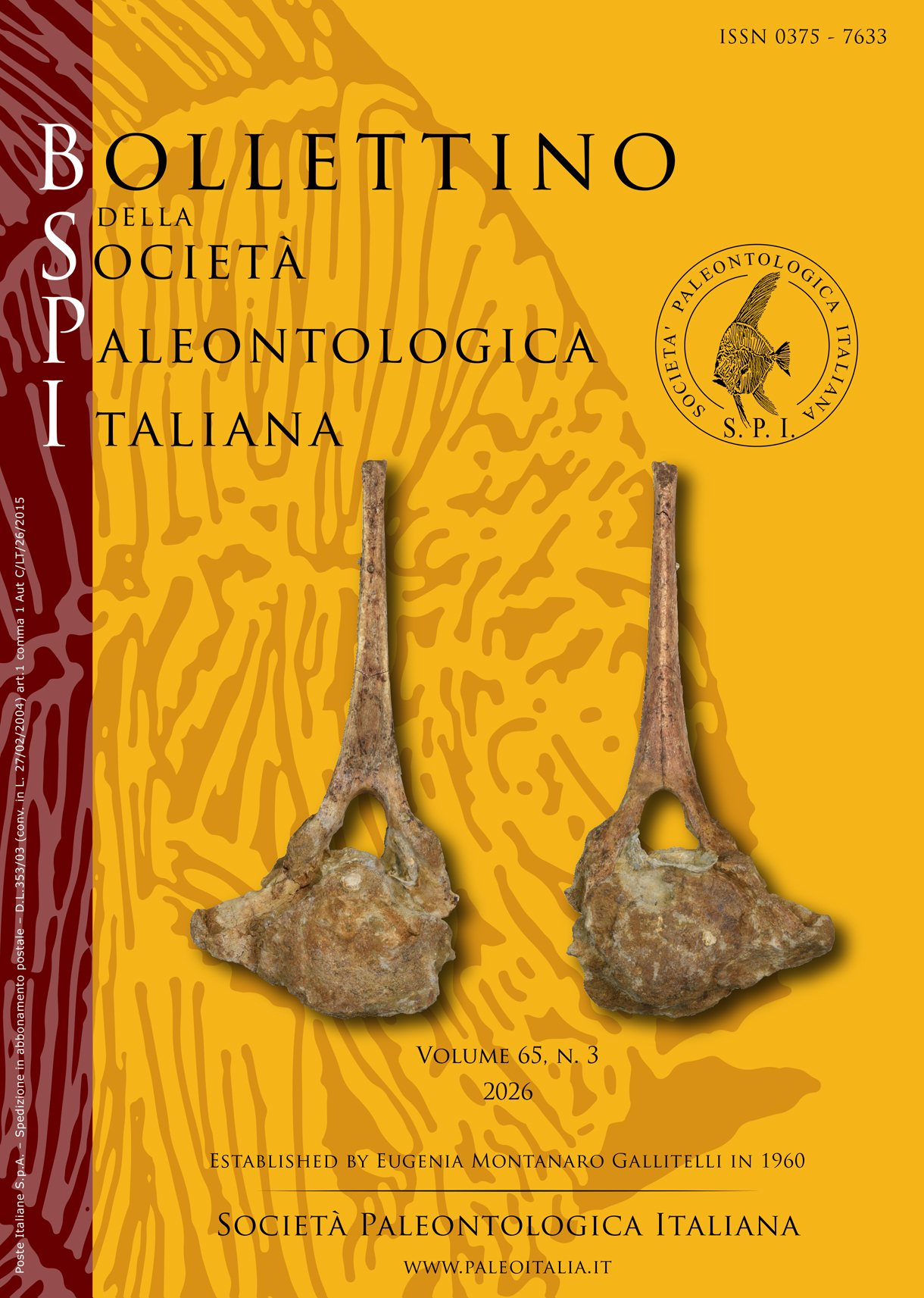
The present paper focuses on the recently discovered Pliocene vertebrate site of La Serra (Valdelsa Basin, Tuscany), near the historical locality of Montopoli (Pisa Province). At La Serra, marine and terrestrial fossils co-occur within a siliciclastic succession of coastal and marginal-marine deposits. The terrestrial mammal fauna includes proboscideans and artiodactyls (suids and cervids). Specifically, the gomphothere Anancus arvernensis is documented by bunolophodont molar fragments and postcranial bones (ribs, vertebrae and a humerus). Fragmentary maxillae and an isolated upper canine are attributed to the small-sized suid Sus arvernensis. Cervids are represented by an antler fragment assigned to Procapreolus cf. cusanus as well as by teeth and postcranial remains of a medium-sized Cervinae somewhat reminiscent of “Pseudodama”. Two mammal-derived coprolites, likely produced by some herbivores, were also recovered. All identified taxa are regarded as forest-dwelling, thereby implying a wooded landscape. The taxonomic composition of the assemblage supports its attribution to the Early Villafranchian Triversa Faunal Unit, which is broadly consistent with the Piacenzian age inferred for the entombing deposits on stratigraphic grounds.